INTERACTIVE SOFT ROBOTIC MAT
Summary
This project investigates how designers can use the body’s natural sensitivity to create technologies that enhance geriatric care. Focusing on touch and body awareness, it explores the potential of soft robotics to stimulate these senses in older adults, considering the effects of sensory decline and neuroplasticity. To this end, an interactive mat was developed to encourage movement and sensory engagement in the lower limbs, serving as a prototype for reflecting on how design can support the aging body through emerging technologies and design.
The design concept
The SOMAT is an interactive mat designed to stimulate tactile and proprioceptive—body awareness—sensitivity of the lower limbs. For this, the design translates proven treatments for somatosensory improvement—creative dance, massage, and skin stimulation—into a product that stimulates receptors in the foot soles, knees, and involved muscles. In the form of a mat, the training is facilitated for the user as an interaction with a familiar, intuitive product.

Top view of the final design concept

Tactile features of the final design concept.
The user and the interaction
The design targets independently living older adults experiencing, or seeking to prevent, somatosensory decline in the lower limbs. Users step on textured, air-filled pouches that transfer air between each other, stimulating sensory receptors in the feet, knees, and leg muscles.
To facilitate somatosensory stimulation, the design builds on research into the somatosensory system and age-related sensory decline, exploring traditional and alternative interventions to improve or prevent it. From this, a home-based training tool was developed to enhance lower-limb awareness in older adults living independently. For more on the research background, the full report can be requested here.
The functional design
Overall, the mat design consists of three layers: a foam base, a soft fluidic circuit and a tactile feedback layer. While the foam base primarily supports comfort and integration of the upper layers, the circuit and tactile feedback layers target the inteded somatosensory stimulation and training:
The soft fluidic circuit
The circuit is a soft pneumatic system controlling airflow among seven Nylon TPU chambers linked by vinyl channels and 3D-printed check valves. It transfers air between chambers to create inflation and deflation patterns in response to the user’s steps.


(Left) Sequence of a pouch deflation when stepped on; and (right) scenarios of use: a) using the tactile feedback paths, b) fitting the mat within the walking aid, and c) using the horizontal mat orientation.
Sequence of circuit fluid distribution according to a specific sequence of the user's steps.

a) Final full closed circuit prototype made with TPU-coated nylon, b) circuit prototype with the largest pouch inflated, c) circuit prototype with medium pouches inflated, and d) circuit prototype with the small pouches inflated.

Schematic of fluidic distribution of the soft circuit.
Each chamber includes a self-sealing valve that closes under pressure and a foam insert enabling controlled airflow between chambers. Air transfers only when a chamber is stepped on, regulated by a one-way check valve combining soft foam and a 3D-printed PLA casing.


a) Self-sealing valve integrated into the chamber: open during inflation and closed upon full inflation due to pressure; b) inflated TPU-coated nylon chamber; c) demonstration of self-sealing mechanism; and d) schematic of the integration of two chambers and a self-sealing valve.


a) Check valve design; b) (top) closed check valve—the foam insert presses against the one-way valve, and (bottom) open valve—the foam insert is compressed by increased pressure, allowing air to flow; c) schematic of two—out of seven—chambers integrated with all circuit components; and d) demonstration of air transfer when all components are integrated.
The tactile feedback
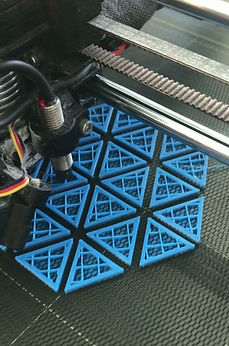
The tactile layer uses 3D-printed textiles to stimulate different foot sole mechanoreceptors through varied textures. Based on research and testing of pattern flexibility and deformation during inflation, several designs were developed and refined.
The 3D-printed textiles function as tactile feedback patches placed above each chamber to stimulate the feet during use. Outlined with Velcro, they are removable for cleaning and customization, while contrasting fabric rings enhance visual guidance. The soft circuit is enclosed in a stretchable fabric layer over a foam base, providing flexibility, support, and seamless integration. Images of the prototype and final CAD model are shown below.


a) Check valve design; b) (top) closed check valve—the foam insert presses against the one-way valve, and (bottom) open valve—the foam insert is compressed by increased pressure, allowing air to flow; c) schematic of two—out of seven—chambers integrated with all circuit components; and d) demonstration of air transfer when all components are integrated.
Overview of tactile stimuli, relevant textures, involved receptors and suitable tactile feedback patterns.

Prototype of the mat: a) all layers integrated, b) top view section, c) angled view section, and d) angled view of an inflated pouch

CAD model of the final design concept with tactile paths included.
Overall key features of the design concept—developed as an in-home training artefact for older adults—include:
-
Household-friendly: Designed for safe, simple, and regular use in home environments.
-
Soft robotics: Employs soft materials and fluidic actuation for gentle and adaptive interaction.
-
Time-bound interaction: Defined start and end points promote structured and consistent use.
-
Tactile stimulation: Incorporates 3D-printed textures that target specific mechanoreceptors on the soles of the feet.
-
Visual and tactile guidance: Combines contrasting fabric colours and textured pathways to support intuitive movement.
-
Hygienic design: A detachable top layer allows for easy cleaning and maintenance.
To dive into this project's research background, design process, evaluation and dicussion, request the full assignment repot here.
Master's thesis assignment
January - August, 2025
#somatosensation
#neuroplasticity
#older_adults
#soft robotics